
1st Year Survival & Success Guide for Women Truck Drivers

Updated: Jun 26
We were recently asked to produce a guide for new women entering truck driver training to help keep them safe and understand the realities of becoming a commercial motor vehicle operator.
The printable PDF is available for download with a free membership QR code at the end for new CDL Graduates.

The purpose for the guide is to welcome new women to the trucking industry and provide authentic information they should have during their CDL training and BEFORE they choose a starter carrier.
Our mission is to deliver highway safety through leadership, mentorship, education, and advocacy.
Our tagline is "Know The Difference" for reason. You can learn more here RWIT and WIT: What is the Difference | The RWIT Community
This information and downloadable booklet was created to help guide and support 1st year CDL students through the critical first year in the trucking industry to develop a safe, successful, and professional career as a commercial motor vehicle operator.

Your CDL is a license to learn.
During your 1st year as a truck driver, you should be laser focused on becoming a safe qualified commercial motor vehicle operator. In order to do this, you need to shut out the noise and be aware of your surroundings.
Industry Realities and Turnover
The trucking industry experiences a consistently high turnover rate; many new drivers leave the profession within their first year. Often, they enter truck driving with unrealistic pay expectations, while others struggle to adjust to the lifestyle, working conditions, and long periods away from home.
Unfortunately, some also encounter personal safety concerns or negative training experiences that derail their progress during the critical early months. This guide is meant to inform you so that you can make better choices during your 1st critical year in the industry.
First year challenges – Personal Safety
Once you graduate with your CDL you will be choosing a starter fleet or “finishing school”. This is a very important decision since you will need to complete a year to be considered “insurable” at a better paying carrier. For women, especially those entering the industry alone, this choice can greatly impact your long-term success.

Professional Conduct
You are going to be working in close quarters with people from different backgrounds who may not have had any proper conduct training. Any trainer or co-driver, regardless of gender, should not be conducting themselves in an unprofessional manner. Professionalism and mutual respect are important in any shared living and working environment.

This is a two-way street. You are entering someone’s home and office as a guest.
Maintain high personal standards by cleaning up after yourself, respecting boundaries, communicating professionally, and conducting yourself in a respectful manner.
Listen to instruction, DO NOT be a “Know it All”. Steer the conversation back to trucking if it starts deteriorating into inappropriate subject matter but do not ignore red flags.
It’s natural to have your guard down at your new job because you are eager to learn and start making money but it’s important you understand the unique isolated environment that you are in.
Maintain professional boundaries with trainers and co-drivers. Avoid highly personal conversations involving your relationships, sex life, finances, or family conflicts.
Not all men are harassers or predators, and having a female trainer DOES NOT automatically guarantee a safe or professional training experience.
Professionalism, boundaries, and conduct matter more than gender alone.
Preparation
Mental Health & Isolation
Going “over the road” (OTR) can be a dramatic change in lifestyle. You may experience some stomach upset from the limited food choices that will be available to you in the early weeks. Make sure to pack over the counter non drowsy medications that you may need like Imodium or Pepto Bismol, Ibuprofen, Gas X and TUMS.
Storage space is sparce on the truck and since there will be two people you should pack lightly to go for your “over the road” (OTR) training. It is not recommended that you buy a lot of things during your first six months in case you have to get off the

truck quickly. You may not be able to take everything with you. Click the image to get a PDF of a suggested packing list.
Before leaving the orientation center for your starter fleet make sure you have several phone numbers and email contacts for multiple divisions that include your dispatcher, fleet manager, their supervisor, safety department, human resources and any special 24-hour incident response unit if your carrier has one.
Use a tracking app with your family and friends like Life360 or Join the REAL Women in Trucking Life360 Community.
The Three Bag System – Shower/Morning/Pit Stop
You may not be able to shower every day during your first weeks on the road, so bring plenty of different wipes to help you freshen up in between your driving shifts. The three-bag system will help you stay organized so that you don’t have to look for things for each different type of stop.
Shower Bag - When you have a shower stop, make sure you have everything already packed to go in a shower bag that you will need (Shampoo/Conditioner/Body Wash/Lotion/Toothbrush/Toothpaste/Hair Products and Styling Tools, etc.) including shower shoes (flip flops) as a precaution for foot fungus.
Morning Bag – For the days when you are not going to be able to shower, have a smaller morning bag you can grab quickly to start or end your day that has your toothbrush, toothpaste, mouthwash, facial and body wipes, baby powder or dry shampoo for your hair along with styling tools, brushes, etc. plus your daily medications and vitamins.
Pit Stop Bag – Your pit stop bag can be a fanny pack or small clutch you can grab anytime when the truck is going to stop so that you can go to the bathroom quickly and have what you need (wipes, feminine products etc.) and not have to dig around to find them.
If your Three-Bag system is set up in advance you can just grab, go and save time.
Routine
While you may not be able to develop your preferred routine during your training period since you will be learning how your trainer operates, you can begin to develop one that works for you.
Getting out of the truck for a walk can help with stiffness and stress. If it is safe, you can walk around during loading and unloading at the shippers and receivers or stop at rest areas where there are clearly marked sidewalks to take a break from the road.
Getting good sleep is critical so that you can drive your shift. Since truck drivers are not allowed to use sleep medications you will need to find natural remedies like calming music or try YouTube videos that have uninterrupted sound therapy for restful sleep.
The road can be solitude, but it can get lonely and your friends and family at home may not be able to relate to what you are experiencing. Try looking up podcasts that are entertaining to you or self-improvement for your life and business. Getting into your head too much isn’t healthy and it can eat at you. When you have downtime, try to visit something unique in the area, go to a restaurant or a shopping mall where you can walk around.
Unprofessional Conduct
Red Flags | |
Excessive questions of a personal nature Pressure to violate hours of service (HOS) | Encouraging you to take medications that can cause drowsiness. Coercing you to perform other unsafe operations. |
Controlling behavior regarding bathroom and shower breaks. | Treating you like you are their property in public spaces and truck stops. |
Blocking sleeper access, rubbing against you. | Retaliation threats that they can have you fired |
Controlling your beverages or food intake | Isolation from communication with dispatch |

If You Feel Unsafe
Contact your carrier representative immediately to help you get off of the truck with your belongings in a safe place.
If you cannot reach anyone or feel like you are not being given correct information you can contact REAL Women in Trucking for assistance.
If you are not being granted a safe trainer reassignment or opportunity to find another safe co-driver report it to REAL Women in Trucking
Document incidents with time, date, and pictures if possible
Share your location with a trusted contact and text them what is going on
Trust your instincts and call 911 law enforcement, if necessary, file a police report immediately if a crime has been committed against you. Get the officer’s name, phone number and email.
If your carrier is discouraging you from making a police report or requiring you to return to headquarters before going to a hospital for treatment that can destroy evidence, this is a major red flag, please contact us.
The human resources (HR) department should be notified but you must understand that they are there to protect the company from being sued. They are not your friend.

Truck Parking and Situational Awareness
We want to make it very clear that most sexual assaults in the commercial motor

vehicle industry DO NOT take place from a random stranger at a truck stop. They occur from a co-worker, a trainer, a co-driver, someone who is ALREADY inside the truck with you. Be aware of the situation.
Never leave the truck without your CDL credential on your person, some truck stops and law enforcement may not understand that you are a trainee or co-driver authorized to be on the truck.
It's true that truck parking remains a major challenge across the United States, especially during peak early afternoon to early morning hours. REAL Women in Trucking has been involved with the FHWA Truck Parking Coalition since its inception, and we were grassroots organizers of "Jason's Law"
Many new drivers rely heavily on large chain truck stops because of fuel rewards programs, but these locations often fill up early in the day. Learning to manage your schedule and plan parking early is an important skill that can reduce stress and improve safety. The RWIT member community on Life360 includes pins to some truck parking places we share with one another in difficult areas. You can request to join it once you are a member and you are out on the road.
Whenever possible, consider adjusting your driving schedule to start earlier in the day so you can park earlier to avoid the evening rush. A tip from experienced drivers is to take showers in the afternoon and also explore smaller independent truck stops, rest areas and family-owned restaurants that offer truck parking which may offer larger parking areas, quieter environments, and access to unique local restaurants.
When parking for the night, develop consistent personal routines that help you feel comfortable and prepared. Many drivers prefer to complete tasks like walking pets, using the restroom, or getting food before settling into a parking space for the evening. Fuel in the morning so that your tanks are not siphoned while you are sleeping.
As with any travel environment, maintain general situational awareness in parking areas, truck stops, and even at hotels, particularly in locations that are poorly lit or unfamiliar. Be mindful of your surroundings and trust your instincts if a situation feels uncomfortable.
Some drivers choose to add extra layers of security to their truck while resting, such as using seatbelts or other devices to reinforce door security. If you use any secondary safety device, make sure you can quickly release or remove it in the event of a fire or other emergency.
Choosing safe truck parking locations, planning ahead, and developing consistent habits can make life on the road more comfortable, restful, and manageable during your first year.
Financial Survival
High pay advertisements are not always reality.
Trucking is filled with recruitment ads claiming that the pay is better, the miles are more, on the other side of the fence. Your first year you should NOT be chasing money, you should be chasing a safe driving record so that you are insurable to go to a better paying carrier.
Realistically, in your 1st year, DO NOT expect your NET income to be more than $37,000. If it is, GREAT! but often it is not when year-end calculations are made. Your pay will not be consistent week after week so stash some emergency funds and try to eat in the truck whenever you can to save money.
Stay away from predatory lease purchase trucks and avoid company hopping. The grass is generally not greener on the other side of the fence. Try to make the best of it and pick your battles carefully UNLESS you are in a dangerous situation that will ultimately escalate. If you need advice, contact us.
Personal Safety Checklist
Weapons are not allowed on the truck, but you should have something to protect yourself that is not considered a weapon that can help you if needed.
Have extra money in case you need to get off the truck and seek immediate help.
Keep your CDL with you at all times on and off the truck.
Use a tracking app with your family and friends like Life360.
Make sure you have emergency contacts and email addresses already programmed on your phone, written down and kept in a safe place.
DO NOT allow others to handle your water bottles, buy your drinks or handle your food when you are on the road, including trainers, co-drivers and co-workers.
Know Your Rights
Discrimination
If you are told that there is a waiting list for women to get OTR CDL Training, we want to know about it. If a recruiter or carrier representative tells you that there is a

waiting list for women who are CDL graduates in order to wait for a woman trainer without providing the option have a male trainer it is a violation of The Civil Rights Act of 1964 Title VII. It is called “Same Gender Training” and it is hiring discrimination.
If you believe that you have been discriminated against at work because of your race, color, religion, sex (including pregnancy, transgender status, and sexual orientation), national origin, age (40 or older), disability or genetic information, you can file a Charge of Discrimination with the EEOC. A charge of discrimination is a signed statement asserting that an employer, union or labor organization engaged in employment discrimination. It requests EEOC to take remedial action. There are time limits for filing a charge.
Coercion
The FMCSA Coercion Rule explicitly prohibits motor carriers, shippers, receivers and transportation intermediaries from coercing drivers to operate in violation of

certain FMCSA regulations, including the drivers' hours-of-service limits, the commercial driver's license (CDL) regulations, the associated drug and alcohol testing rules, HMRs, and some of the FMCCRs. To report coercion, visit the FMCSA website and file a complaint through the National Consumer Complaint Database (NCCD).

The Surface Transportation Assistance Act (STAA), 49 U.S.C. §31105 provides Whistleblower Protections for Truck Drivers who are being coerced to operate in unsafe conditions.
49 CFR § 392.3 – Ill or fatigued operator "No driver shall operate a commercial motor vehicle, and a motor carrier shall not require or permit a driver to operate a commercial motor vehicle” when fatigue, illness, or another condition makes it unsafe to begin or continue driving”
49 CFR § 392.14 – Hazardous conditions; extreme caution Requires drivers to use extreme caution when hazardous conditions affect visibility or traction, including:
Snow, Ice, Sleet, Fog , Smoke, Rain, Dust, Other hazardous conditions. The regulation states that if conditions become sufficiently dangerous, operation shall be discontinued and shall not resume until the vehicle can be safely operated. The critical language is essentially: “If conditions become sufficiently dangerous, operation shall be discontinued…”
This does not mean you can shut down in any weather condition. It means if the weather is so extreme and you can document it and have communicated it to your dispatch you have protection. (See Cynthia Fergusson V Prime)
Protected Activities

You may not be fired, disciplined, or otherwise retaliated against for:
Filing a complaint or participating in a proceeding about a CMV safety, health, or security violation.
Cooperating with federal, state, or local safety/security investigations
Providing information to agencies about accidents or incidents involving CMVs
Accurately reporting hours of service (HOS)
Refusing to operate a vehicle if doing so would violate a federal CMV safety rule or if you have a reasonable apprehension of serious injury to yourself or the public
For more information visit the Department of Labor Occupational Health and Safety website
Retaliation
Retaliation occurs when an employer or colleague takes a materially adverse action against an employee because they engaged in a legally protected activity,
such as reporting under STAA, sexual harassment, participating in an
investigation, or supporting a coworker’s complaint.
Protected activities include internal complaints to HR or management, filing charges with the EEOC, or assisting in investigations, even if the original harassment claim is later found to be unfounded, provided it was made in good faith.
Retaliation after reporting sexual harassment is illegal and can take both overt and subtle forms, but employees are protected under federal and state laws.
If you work in the CMV industry and engage in protected activity under STAA, you are shielded from retaliation. If you believe you have been retaliated against, you can file a complaint with the Department of Labor within the statutory time limit to seek redress.
Documentation and Reporting
Documentation is extremely important if a situation escalates or legal action becomes necessary. Keep detailed records of incidents, including dates, times,

locations, messages, photographs, witness information, and the names of anyone you reported concerns to — even if the issue initially seems minor.
False accusations can have lasting consequences for you. It is critically important that anything you report can be reasonably documented given the circumstances.
If you experience a physical or sexual assault, seek immediate medical attention and contact law enforcement in the jurisdiction where the incident occurred. Request that an official report be taken and preserve any potential evidence as soon as possible.
Be cautious of anyone discouraging you from contacting police, seeking medical care, or documenting the incident. Your safety, health, dignity and legal rights should always come first. If you need guidance please contact us.
YOU ARE NOT ALONE

RESOURCES
RAINN is America’s largest anti-sexual violence nonprofit, providing confidential,

trauma-informed, 24/7 support services to survivors and their loved ones.
Domestic Violence is also prevalent in the trucking industry. If you are in a situation that you need to get off the truck and your carrier is not assisting you, you can try searching for local area domestic violence programs at DomesticShelters.org to quickly find services and information best suited for your location, language and needs.
Sexual Assault and Sexual Harassment (SASH) in the Commercial Motor Vehicle Industry
Over-the-road truck driver training is unique because it requires unsupervised co-habitation for weeks at a time as a condition of employment.

Getting a local driving job right out of CDL School is rare due to insurability but even with a local job there is no guarantee you will not be subjected to some form of gender-based violence and harassment in the workplace. It’s imperative that you understand that a trainer or co-driver who perceives that you are vulnerable may attempt to exploit this unique living and working environment.
Gender Based Violence and Harassment (GBVH) has been a recognized International Workplace Safety Issue over the past 20 years.

International supply chains have increasingly worked towards to creating workplaces that are free from sexual assault and sexual harassment.
In the United States, the construction, hospitality, agriculture industries and women in the trades are addressing gender-based violence and harassment in the workplace through training and accountability measures, however the trucking industry has lagged behind.
The information presented here is not intended to scare you but rather to help

be realistic about the working conditions during truck driver training at your starter carrier.
It is important to understand these risks and develop a safety plan before you choose a starter company in order to avoid situations that can escalate and become personally dangerous.
Rank Your Training Carrier
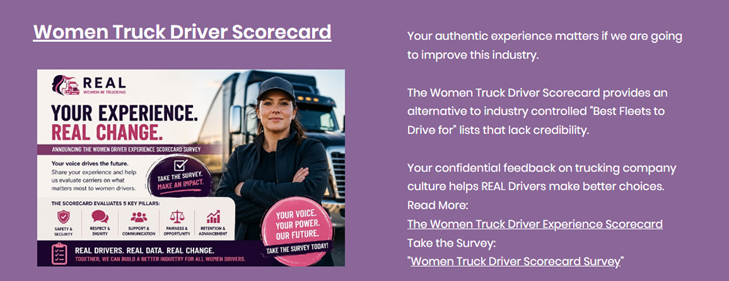
After your training is completed and you are driving solo at your experienced level carrier for 1 year or more, we invite you rank your training carrier to help us evaluate how they are doing by taking the women truck driver scorecard survey
Upon graduation from your CDL School you can also sign up for a FREE REAL Women in Trucking Membership using promo code "FirstYear".
If you are a CDL School administrator, we urge you to inform and educate women entering truck driving with this information.
If you are a trucking carrier and want to learn more on how to improve your culture with real accountability for driver conduct and retention, contact us. info@realwomenintrucking.org
Download the PDF - (Print both sides for 6 color pages)


Dealing with shippers, parking, and safety takes time to master. Sent this to a rookie driver and checked it on an og image checker so the thumbnail card rendered nicely in text
It is useful to have a simple reference when trying to access router configuration settings. The information on 10.0 0.1 can assist users in understanding network access, checking available settings, and dealing with common router-related problems without unnecessary confusion.
mình có lần lướt đọc mấy trao đổi trên mạng شيخ روحاني thì thấy nhắc nên cũng tò mò mở ra xem thử cho biết. mình không tìm hiểu sâu chỉ xem qua trong thời gian ngắn để quan sát bố cục cách sắp xếp جلب الحبيب các mục và trình bày nội جلب الحبيب dung tổng thể. cảm giác là các phần được trình bày khá gọn, các hurentest berlin mục rõ ràng Huren Berlin nên đọc lướt cũng không bị rối với mình như vậy là đủ để nắm tin cơ bản rồi. جلب الحبيب
👍
This guide nails the real talk about training and safety—wish I’d had this before my first solo run. I’ve been sharing it with my new classmates, and now I’m checking out https://dreamina-ai.pro
This guide offers practical information for people who want to become more familiar with network configuration. I especially liked the simple explanations. 192 l.168.10.1 can be associated with router administration on compatible equipment, where users can adjust wireless options and review important connection settings.